
Why Big Pharma Is Spending Billions on Drugs It Didn’t Invent
- Evan Wang
- 6 hours ago
- 2 min read

Would you take a chance on a drug that is unfinished but could generate billions in future revenue?
For the world’s largest pharmaceutical companies, the answer is yes.
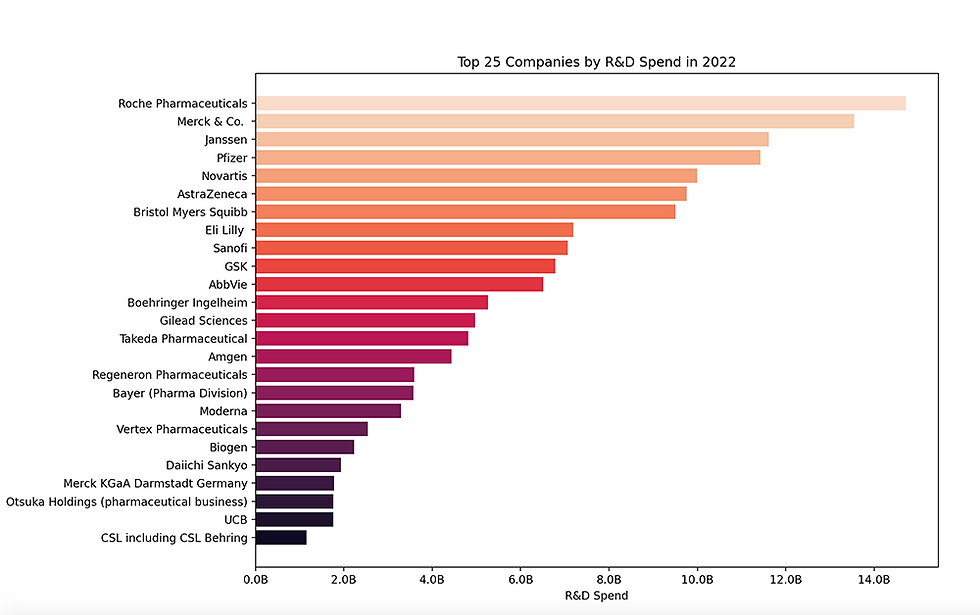
Rather than discovering a drug from scratch, Big Pharma has increasingly begun licensing and acquiring drugs from smaller biotech companies or outright buying the companies as a whole. However, they aren’t investing in a finished result, but in a set of rights, patents, and pipelines. While you may think they are gambling on a molecule, there are a few reasons why they do so.
First is the patent cliff. Under its patent, a drug—facing limited competition—is extremely profitable, with the ability to generate billions in annual revenue. However, after the patent expires, its market is flooded with generic, cheaper alternatives, causing a huge decline in sales for the original company. Pharma companies are therefore incentivized to replace old blockbuster drugs before their value expires.
The obvious solution to this problem is to create a new drug. But developing a medicine is extremely difficult, as it goes through years of laboratory research and waves of clinical trials before it can enter the market. And along the way, most candidates fail. That is why, for big pharmaceutical companies, it’s much safer and more valuable to purchase a drug that has already undergone some of the stages of development.
Consider two choices:
First, a company beginning to discover a medicine in which they will spend years researching and testing candidates. All while the chance of it failing is more likely than not.
Or, that same company could acquire a smaller biotech company that has already produced a drug with promising clinical data and that has completed some stages of development.
Although spending billions on unfinished drugs may be unfathomable to some, these companies aren’t just buying a medicine, but buying time and reduced uncertainty.
Of course, purchasing an unfinished pipeline has its own risks. It could still fail, and the company would consequently have spent billions with zero return. A multibillion-dollar investment would turn into a multibillion-dollar loss. However, a pipeline could also contain massive amounts of revenue in its future. That is exactly what makes biotech investing exciting and unusual. The value of an experimental drug is constantly changing as scientists generate new evidence and investors are continuously translating that evidence into probabilities of future success and financial value. Drug discovery may start at the bench, but its future is ultimately decided by capital allocation.
For Big Pharma, the question is no longer, “What should we invent next?”
Now it's, “What is someone else’s invention worth to us?”


