
Topic Of the Week - Hedge Funds

What is a Hedge Fund?
Hedge funds represent limited partnerships of private investors managed by skilled fund managers who employ diverse strategies to achieve returns above the average market performance.
a)"hedge" in hedge funds refers to hedging potential losses and risks by investing in opposing positions within the fund's portfolio
b)Require a high minimum investment or net worth from accredited investors.
c) Accredited investors are individuals or businesses allowed to trade securities not regulated by financial authorities like the SEC, meeting specific income, net worth, or investing knowledge criteria.
d)Unlike a bank and other types of funds, they can take on higher risks since they are not subject to the same regulations

What are some strategies for hedge funds?
First, what is a long/short strategy? What is market neutral?
1. Long/short strategies involve taking opposing positions in competing companies within the same industry, based on relative valuations.
Long/short equity hedge funds typically have net long market exposure because their entire long market is not shorted.
The unhedged long positions may vary so there is a little market timing to the overall return.
2. Take long and short positions in different securities or assets to minimize exposure to overall market movements.
Lower risk than a long-biased strategy
Lower expected returns

Second, What are some more specialized strategies?
1. Event-driven - capitalize on temporary stock mispricing resulting from corporate events like mergers, acquisitions, or bankruptcies.
2. Fixed Income—focuses on capital preservation through long and short positions in fixed-income securities like bonds.
3. Quantitative—employ computer models and algorithms to analyze vast amounts of data for making investment decisions.
4. Option Based - utilizes options contracts as a primary instrument in its investment strategy, in which they can also employ neutral or long strategies
5. Arbitrage—strategies aim to exploit price discrepancies between related securities or assets
6. Distressed Debt—Invest in financially troubled companies' debt to profit from potential recoveries.
7. Global Macro Funds—broad macroeconomic trends and global events, aiming to profit from changes in currencies, interest rates, commodities, and equity markets across various regions.

What is the history of hedge funds?
1949: Alfred Winslow Jones establishes the first hedge fund, using a long/short equity strategy.
introduced the long/short equities model with an initial investment of $100,000
1969: Michael Steinhardt forms Steinhardt, Fine, Berkowitz & Co., one of the earliest hedge funds to achieve significant success.
1970s: Hedge funds gain popularity, attracting wealthy investors with their flexible and alternative investment strategies.
emphasized stock selection over market returns
1980s: The industry expands, with the number of hedge funds growing and strategies diversifying beyond traditional long/short equity.
1990s: Hedge funds face scrutiny after the Long-Term Capital Management (LTCM) collapse, leading to increased regulatory attention.
2000s: Hedge funds continue to grow, and strategies evolve to include global macro, event-driven, and quantitative approaches.
2008 Financial Crisis: Many hedge funds suffer losses during the financial crisis, leading to increased redemption requests and closures.
Exemption) Michael Burry and Scion Capital successfully capitalized by foreseeing the subprime mortgage market collapse, taking significant short positions against mortgage-backed securities through credit default swaps, resulting in substantial profits.
Post-Crisis: The industry rebounds, but increased regulatory oversight and changes in investor sentiment impact fund operations.
2010s: New strategies like algorithmic and high-frequency trading, but also new challenges like fee pressure.
2020s: New ESG (Environmental, Social, Governance) considerations gaining importance.
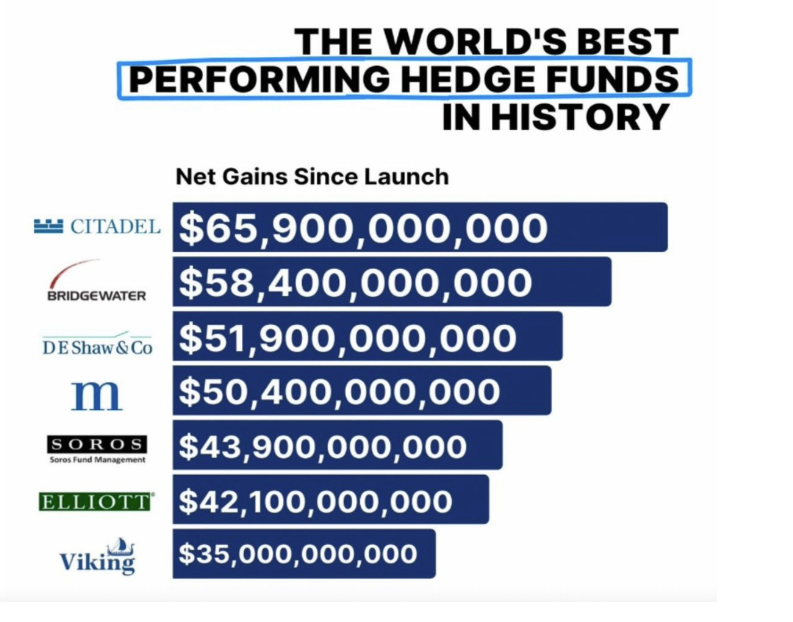
ex) Bridgewater focuses on macroeconomic trends, risk parity, and radical transparency, managing an impressive AUM of $123.5 billion and leaving a notable impact on the investment industry.
What are the tax implications of hedge funds?
Long-Term Capital Gains Tax Rate:
The long-term capital gains tax rate is based on an investor's marginal tax rate.
Rates for long-term capital gains can range from 0% to 20%.
Taxation of Fixed Income:
Hedge funds generating fixed income from sources like interest income, dividends, and short-term trading gains are subject to ordinary income tax rates.
Ordinary income tax rates are typically higher than long-term capital gains rates.
Pass-Through Entity Structure:
Many hedge funds are structured as pass-through entities (e.g., partnerships or LLCs).
This structure requires individual investors to report income and gains on personal tax returns.
Complex Tax Reporting:
Investors must navigate intricate tax implications associated with their hedge fund investments.

What are the fees associated with hedge funds?
1. Managers commonly receive performance fees and management fees, known as carried interest, as part of their compensation.
2. The management fee structure usually includes a 1-2% charge on a fund’s net asset value every 12 months.
3. The performance fee (incentive fee) is around 20%, which is on all the investors’ earnings.
Note: Hedge fees have fallen to about 1.4% and 16.4%.
For instance, if a hedge fund generates a million dollars in profit for an investor, $200,000 is allocated as the performance fee.

Works Cited:


