The 5.34% Shaking Wall Street
The stock market often seems to grab the largest amount of investor attention, yet this week one of the biggest moves happened elsewhere. On Thursday, October 1st, the yield on the 10-year U.S. Treasury reached 5.34%, which is its highest level since 2002.
Treasury yields represent the return that investors demand to lend money to the U.S. government. Recently, investors have been selling bonds over concerns about inflation, oil prices, economic growth, and an increase in government borrowing. Since bond prices and yields move in inverse directions, that selling of bonds has pushed yields higher. The 10-year yield rose more than 80 basis points during Q3 alone.
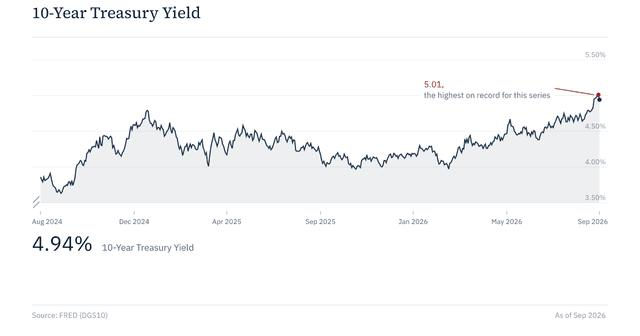
This is significant because the 10-year Treasury is, to an extent, the benchmark for borrowing across the economy. When its yield increases, mortgage rates, corporate borrowing costs, and other interest rates tend to face pressure.
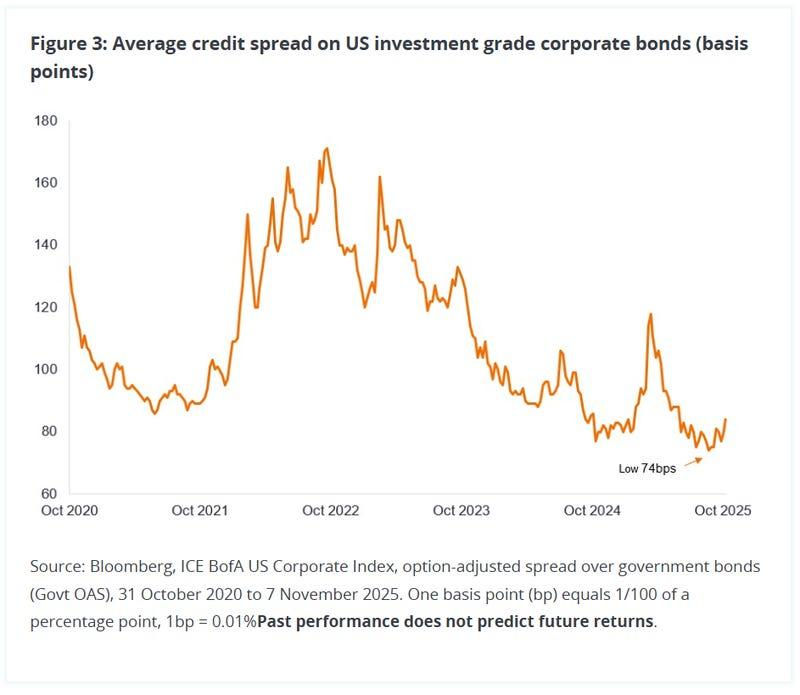
This move largely affects the credit market. Companies frequently raise money by issuing bonds, whose yields are priced relative to safer Treasury securities.
As Treasury yields rise, companies generally have to offer higher yields on their own debt to attract investors. This makes borrowing and refinancing much more expensive, and can lead to companies being discouraged from taking on debt to fund new investments.
The effects also extend to stocks, specifically expensive tech companies. Investors value companies partly by estimating how much their future profits are worth today. Higher interest rates reduce the present value (PV) of those future earnings, potentially lowering how much investors are willing to pay for the same company.
There is also a tradeoff for investors. If U.S. government debt can offer returns above 5%, stocks and corporate bonds must offer enough return to compensate investors for taking a greater risk. This can pull money towards safer fixed-income investments and put pressure on riskier assets.
The 10-year Treasury may seem like just another number on the Bloomberg terminal, but at 5.34%, it is changing the price of borrowing and investing throughout the entire economy.